Safeguarding
Safeguarding
REPORTING ABUSE
If you are concerned about the welfare of a child or adult at risk, do not delay in contacting the police, using 999 if a child or adult is believed to be in immediate danger.
It is the policy of the Catholic Church in England and Wales to report all allegations of abuse to statutory authorities, regardless of whether the abuse occurred recently or in the past, or whether the accused person is living or deceased.
If you are in any role within the Catholic Church in England and Wales, you must refer allegations directly using the contact details below, or directly to the Police.
CONTACT DETAILS
FR TIM BUCKLEY, CSsR (PARISH PRIEST) at the monastery
or
RELIGIOUS LIFE SAFEGUARDING SERVICE either by Email: or phone Phone: 0151 556 2311
If you are a member of the public, please refer allegations directly to the police and also to the safeguarding office in your diocese; (the relevant Diocesan safeguarding office can be located using the interactive map on the links page of the CSAS website www.csas.uk.net - contact details will be shown when you click on the relevant area of the map). You can also contact CSAS by telephoning 0207 901 1920 or via email at
SAFE SPACES:
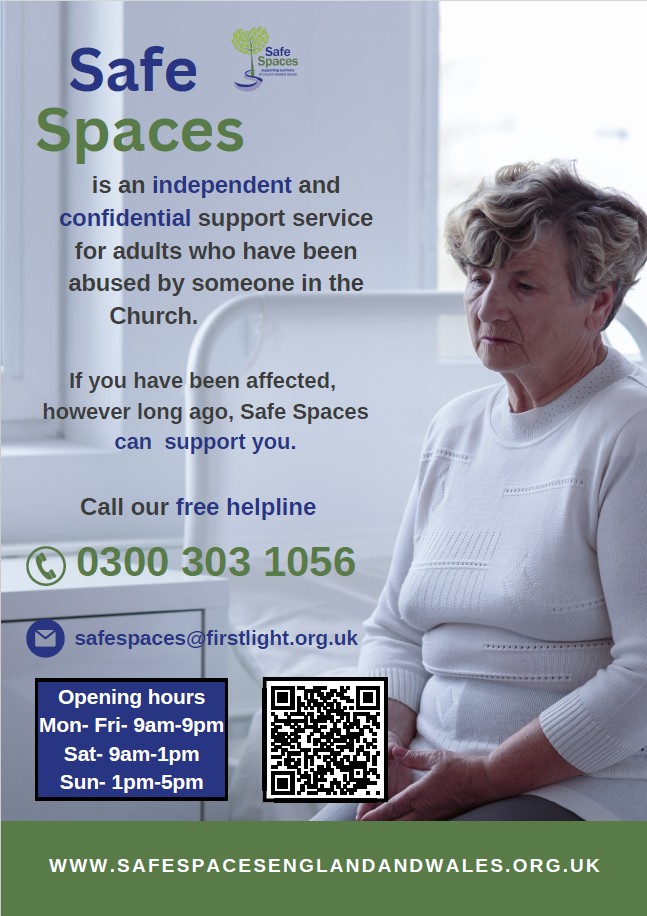
Safe Spaces is a free and independent support service, providing a confidential, personal and safe space for anyone who has been abused through their relationship with either the Church of England or the Catholic Church in England and Wales.
A telephone helpline and live chat is available 0300 303 1056 LiveChat/ Website safespacesenglandandwales.org.uk.
SAFE SPACES

Website: www.safespacesenglandandwales.org.uk/
Phone nunber: 0300 303 1056 (Opening times : Mon-Wed: 10am – 6pm;Thursday: 12pm – 8pm; Fri-Sat: 10am – 6pm; Sun: Closed
SAFE SPACES:
Safe Spaces is a free and independent support service, providing a confidential, personal and safe space for anyone who has been abused through their relationship with either the Church of England or the Catholic Church in England and Wales.
A telephone helpline and live chat is available 0300 303 1056 LiveChat/ Website safespacesenglandandwales.org.uk.
SOURCES OF HELP
https://www.gov.uk/government/publications/covid-19-guidance-for-the-public-on-mental-health-and-wellbeing
“The Hub of Hope is the world’s first of its kind mental health database bringing grassroots and national mental health services together in one place for the first time ever.
Using the location of web browser or mobile devices, the cloud-based web application allows anyone, anywhere to find the nearest source of support for any mental health issue, from depression and anxiety to PTSD and suicidal thoughts, as well as providing a ‘talk now’ button connecting users directly to the Samaritans.
It is currently the biggest and most comprehensive resource of its kind, with more than 1,200 validated support networks already registered on the web app and this number increasing each day. I
t has been endorsed by the Samaritans and 25 other national mental health support organisations and trusts. It already has a proven record of providing support to thousands as a vital stopgap for those on the five to six month NHS waiting list for mental health referrals.”
The Samaritans operates a 24-hour service available every day of the year. If you prefer to write down how you're feeling, or if you're worried about being overheard on the phone, you can email Samaritans at
The Silver Line is a free confidential telephone helpline offering information, friendship and advice to older people in the United Kingdom, available 24 hours a day.
Students against depression is a website for students who are depressed, have a low mood or are having suicidal thoughts.
Childline (0800 1111) runs a helpline for children and young people in the UK. Calls are free and the number won't show up on your phone bill.
NSPCC
NSPCC https://www.nspcc.org.uk/ 0808 800 5000
Kind to your mind
Developed for Merseyside and Cheshire, with access to online therapy courses developed by medical professionals. https://kindtoyourmind.org/
A MESSAGE FROM THE SAFEGUARDING TEAM
Unfortunately, even during the lockdown, there are still safeguarding issues as individuals find new ways to target the vulnerable. We received an email from the Safeguarding department this week and would like to share it with as many of our parishioners as possible, and especially if you can share with neighbours, family and friends who do not receive the bulletin online.
“By now, sadly, you will have also seen a number of news reports that some groups that have been using videoconferencing, social media etc to support their work have sadly also experienced some quite nasty and distressing incidents. There have been a number of reports of Zoom calls being Zoombombed (an individual intrudes uninvited into a Zoom call) and distributing distressing material or comments, live streams being hacked, and people joining online groups with the intention of grooming children and young people.
CSAS have put together the attached guidance document in respect of using videoconferencing for ministry, which will hopefully support you and give you confidence in using technology during ministry safely. Please do use the guidance in considering any form of online ministry, and review your procedures in light of the guidance.
Guidance_on_safeguarding_in_the_use_of_videoconferencing_for_ministry.pdf
I would also suggest that enclosed in this document is a section of ‘Useful links and resources for internet safety’ within this document. CSAS have hyperlinked a number of really informative charities that I use regularly to inform my practice, and I find really helpful as a parent. It may be helpful to share those links with your parish communities, as parents and carers try to guide children and young people through our accelerated use of an online world.
I would also draw your attention to sections 8 & 9 of the CSAS Creating a Safer Environment document which also has guidance on the use of technology, and photography and filming including live streaming church services. https://www.csas.uk.net/wp-content/uploads/2018/11/Creating-a-Safer-Environment-1.docx"
Any questions on either document should be sent to
REPORTING ABUSE
If you are concerned about the welfare of a child or adult at risk, do not delay in contacting the police, using 999 if a child or adult is believed to be in immediate danger. It is the policy of the Catholic Church in England and Wales to report all allegations of abuse to statutory authorities, regardless of whether the abuse occurred recently or in the past, or whether the accused person is living or deceased.
If you are in any role within the Catholic Church in England and Wales, you must refer allegations directly to the safeguarding office for your diocese or religious congregation, or directly to the Police. If you are a member of the public, please refer allegations directly to the police and also to the safeguarding office in your diocese; (the relevant Diocesan safeguarding office can be located using the interactive map on the links page of the CSAS website www.csas.uk.net - contact details will be shown when you click on the relevant area of the map). You can also contact CSAS by telephoning 0207 901 1920 or via email at
#YouAreNotAlone
At home shouldn’t mean at risk, but sadly for many people the lockdown has meant that they are trapped in isolation with their abuser under a pressurised situation.
Over the weekend, the government launched its #YouAreNotAlone domestic abuse campaign to reassure victims of domestic abuse that there is still help for them during the Covid crisis.
If you need to leave your home to escape domestic abuse. (Gov.uk, Covid19 and domestic abuse) the COVID-19 household isolation does not apply
Domestic abuse is a serious crime. Anyone can be a victim of domestic abuse, regardless of their gender, age, ethnicity, socio-economic status, sexuality or background.
KEY POINTS
- If you are in immediate danger, call 999 and ask for the police - the police will continue to respond to emergency calls.
- If you call 999 from a mobile and cannot speak, press 55 to Make Yourself Heard (link embedded to scheme) and this will transfer your call to the police. Pressing 55 only works on mobiles and does not allow police to track your location.
- National Domestic Violence Helpline - 0808 2000 247 or www.
nationaldomesticviolencehelpli ne.org.uk
SOURCES OF HELP
- Childline – 0800 1111
- Refuge – 0808 2000 247 (National Domestic Abuse Helpline)
- Women’s Aid
- Men’s Advice line - 0808 801 0327 (weekdays 9am-5pm)
- The Mankind Initiative - 01823 334244 (Mon-Fri 10am-4pm)
- National Lesbian, Gay, Bisexual and Trans Domestic Violence helpline - 0800 999 5428
- Respect Phoneline offers confidential advice and support to help domestic violence perpetrators stop being violent and abusive to their partners or ex-partners. 0808 802 4040
(With Thanks to the Archdiocescan safeguarding officer Alex for providing us with the above information)
Little Church and Children’s Liturgy:
A celebration of the Liturgy of the Word for children aged 3-11 years.
Parents may attend for the first 2/3 sessions to help their children settle into the group.
Any parent wishing to attend the group regularly, apart from if they are attending solely to assist their child who has a disability, must become a leader or a designated helper and apply for DBS clearance in accordance with the Archdiocesan Safeguarding procedures.
These procedures have been set by the Archdiocese for the protection and safety of the children.
NSPCC VIDEO SERIES ON KEEPING SAFE ON LINE
The NSPCC are creating an online video series to help parents keep their children safe on-line
To learn more visit
</p?